 by
Starter motors get replaced frequently and unnecessarily, because the symptoms of a failing starter overlap almost completely with the symptoms of a poor connection somewhere in the circuit. The starter draws an enormous current, so any resistance anywhere in that path produces exactly the behaviour people attribute to the motor.
How the circuit works
Turning the key sends a small current to the starter solenoid. The solenoid does two things: it pushes the pinion gear into mesh with the flywheel ring gear, and it closes a heavy-duty switch connecting the battery directly to the motor. The motor then turns the engine over.
Because the motor needs several hundred amps, the main feed cable, its connections and the earth path all matter enormously. A connection that would be perfectly adequate for a headlight is nowhere near adequate here.
Safety notes
Disconnect the battery negative terminal first and reconnect it last where a job requires isolation. Batteries give off hydrogen and can explode if ignited, so keep sparks and flames away, and wear eye protection as battery acid causes burns.
Disconnecting the battery on a modern van can lose stored settings and may require relearn procedures afterwards. Never bypass a fuse with a higher rated one or with wire, as fuses protect against fire.
Read the noise
This is the most efficient diagnostic step available and costs nothing.
A single loud click, engine does not turn
The solenoid is engaging but the motor is not turning. Points at a heavily discharged battery, a poor main feed or earth connection, worn brushes inside the motor, or a seized engine. Note that a hydraulically locked or seized engine also produces this.
Rapid clicking
The solenoid is engaging and immediately dropping out because voltage collapses under load. Almost always insufficient current: a flat or failed battery, corroded terminals, or a poor earth. Rarely the starter itself.
Complete silence, no click
No signal reaching the solenoid. Look at the ignition switch, starter relay, fuses, the clutch or neutral safety switch, the immobiliser, or the small trigger wire to the solenoid.
Slow, laboured cranking
The engine turns but too slowly to start. Usually battery condition or cable resistance, sometimes a failing motor drawing excessive current, and occasionally an engine problem such as very heavy oil in cold weather.
A whirring or spinning noise with no engine rotation
The motor is spinning but not engaging. Points at the pinion, the solenoid actuating mechanism, or damaged flywheel ring gear teeth.
A harsh grinding on engagement
Pinion or ring gear tooth damage. Worth investigating promptly, because continued attempts damage the ring gear further, and replacing that is a gearbox-out job.
Diagnostic sequence
1. Battery under load
Check: Measure battery voltage while cranking.
Result and next action: Voltage collapsing well below about 10 volts on a fully charged battery indicates the battery cannot deliver current and has failed internally. Fix this before looking at the starter. See battery and charging fault testing.
2. Clean and check every connection
Check: Battery terminals, the main earth strap at both ends, the engine-to-body earth, and the starter main feed terminal.
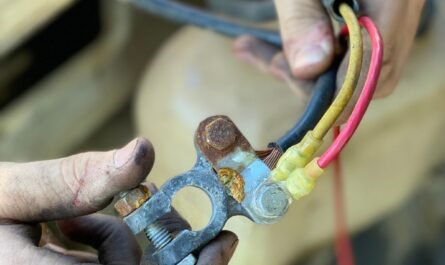
Next action: This resolves a substantial share of starter complaints at no parts cost. Corrosion at the engine earth is a particularly common and well-hidden culprit.
3. Voltage drop test the circuit
Check: With the engine cranking, measure the drop along the positive feed from battery to starter, and along the earth path from starter body back to battery negative.
Result and next action: This is the definitive test. Low drop with good battery voltage at the starter but no rotation means the starter is at fault. Significant drop means the fault is in the cables or connections, and a new starter will not fix it.
4. Check the trigger signal
Check: With the key at crank, measure voltage at the small solenoid trigger terminal.
Result and next action: No voltage means the fault is upstream: relay, ignition switch, clutch or neutral switch, or immobiliser. Voltage present with no response means the solenoid or motor.
5. Check the safety switches
Check: On manual vans, the clutch pedal switch. On automatics, the gear position sensor.
Next action: These are common and inexpensive failures that produce complete silence and are frequently mistaken for a dead starter. Try starting with the clutch pressed fully, and on an automatic try both park and neutral.
6. Consider the immobiliser
Check: Watch for an immobiliser symbol. Try the spare key.
Next action: Some systems inhibit cranking entirely. If the spare key works, the problem is the first key. See immobiliser and key problems.
Heat soak: the intermittent case
A pattern worth naming, because it confuses people. Some starters work when cold but refuse when the engine is hot, typically after a short stop. Heat increases resistance in the windings and expands components, so a marginal starter fails only when hot. If your van starts perfectly first thing but refuses after a delivery drop, this is the likely explanation, and it is a genuine starter fault even though it tests fine cold.
Indicative UK costs
Broad context only. Cleaning connections may cost nothing. A clutch or neutral switch is usually inexpensive. A reconditioned starter commonly runs from around a hundred pounds into the low hundreds, with labour depending heavily on access, which on some vans means removing components to reach it. Ring gear damage means gearbox removal and is a much larger job. Get quotes.
Common mistakes
- Replacing the starter on rapid clicking. That symptom is almost always current supply, not the motor.
- Skipping the earth straps. The most commonly overlooked cause.
- Not voltage drop testing. The one test that gives a definitive answer.
- Repeated cranking attempts. Flattens the battery and can damage the ring gear if the pinion is not meshing.
- Hitting the starter with a hammer as a diagnosis. It sometimes frees a stuck solenoid or brushes temporarily, which does tell you something, but it is not a repair and can damage the unit.
- Ignoring grinding noises. Ring gear damage escalates quickly and expensively.
When to stop and get help
Stop and get help if you hear grinding on engagement, if the engine will not turn at all and the battery is known good, or if you smell burning from the starter area. Do not keep cranking an engine that will not turn, as this can indicate a seized or hydraulically locked engine where continued attempts cause serious damage. See our no-start diagnostic sequence.
Prevention
Keep battery terminals and earth straps clean and protected. Have the battery tested annually before winter. Address slow cranking when you first notice it rather than waiting for a complete failure. Avoid holding the key at crank for long periods, which overheats the motor.
Frequently asked questions
Why does it only fail when hot?
Heat soak. Resistance rises and components expand, so a marginal starter fails only once warm. It is still a genuine fault.
The battery is new but it still just clicks.
Check the terminals and, above all, the earth straps. Then voltage drop test the circuit.
Can I bump start a modern diesel van?
It is generally not advisable on modern vehicles and is not possible on automatics. Immobiliser and electronic systems may prevent it, and it can damage the catalyst or DPF. Jump starting following the handbook procedure is the better option.
Is a reconditioned starter worth it?
From a reputable rebuilder, generally yes, and often good value against a new original equipment unit.
This guide is general information for UK van owners, not vehicle-specific repair instructions. Procedures, tolerances and component layouts vary by engine code and model year. Confirm any figures against your VIN and manufacturer workshop information, and see our Disclaimer before carrying out any work.