
 by
The dual mass flywheel is one of those components most van owners never think about until they are handed a quote that is noticeably larger than they expected for a clutch job. Understanding what it does, and why it wears, helps make sense of that quote and of whether it genuinely needs replacing.
What it does and why vans have one
A diesel engine delivers power in strong pulses rather than smoothly. Those torsional vibrations, transmitted straight into the gearbox, cause noise, gear rattle and accelerated wear. A dual mass flywheel splits the flywheel into two masses connected by springs and damping, absorbing those pulses before they reach the transmission.
The result is a quieter, smoother driveline and reduced stress on gearbox components. The cost is a wearing item with a finite life, containing springs and friction surfaces that degrade over time.
Safety notes
Allow the engine to cool before working near the turbo, exhaust or manifold, as these retain heat for a long time. Never work under a van supported only by a jack. Use axle stands rated for the weight at the manufacturer support points, on firm level ground, with the parking brake applied and the wheels chocked.
Keep hands, tools, loose clothing and hair clear of belts, pulleys and cooling fans whenever the engine may run. A cooling fan can start unexpectedly. Where a check requires the engine running, plan how you will reach the ignition before you start.
Symptoms
Rattle at idle that changes with the clutch pedal
The most characteristic symptom. A metallic rattle or chatter from the bellhousing area at idle, particularly noticeable in neutral with the clutch pedal up, which changes or disappears when the pedal is depressed.
Some noise at idle is normal on a diesel van, so the useful signal is change over time. A rattle that has appeared recently or is getting steadily worse is meaningful.
Rattle on engine shutdown
A distinct clatter as the engine stops, when it passes through low speeds and the damping springs are worked hardest. A well-known indicator worth listening for deliberately.
Judder on pull-away
Vibration through the vehicle as the clutch engages, often worst from cold or when moving off gently. Note this overlaps completely with clutch and mounting problems, which is why the two components are usually assessed together. See our guide to clutch wear symptoms.
Vibration at particular engine speeds
Vibration felt through the floor or gear lever within a specific rev band, often at lower engine speeds under light load.
Gear selection difficulty or gearbox rattle
A failing flywheel no longer damps effectively, so the gearbox receives vibration it was not designed to absorb. This can cause gear rattle and, over time, contributes to gearbox wear.
Burning smell or visible debris
Advanced failure. The internal friction surfaces can overheat, and in severe cases grease escapes from the unit. At this stage it needs replacing without delay.
Why they wear out
- Normal ageing. Springs and friction surfaces fatigue over time and mileage.
- Heavy loads and towing. Vans working near their limits stress the unit more.
- Labouring the engine. Pulling away in too high a gear, or driving at low revs under load, works the damper hard. This is probably the most significant driver-influenced factor.
- Excessive clutch slipping. Heat transfers into the flywheel.
- Engine faults. A misfire or faulty injector produces uneven torque delivery that the flywheel absorbs, accelerating wear. See diesel injector problems.
- Stop-start systems. More start events means more passes through the low-speed range where the damper works hardest.
Diagnostic sequence
1. Listen systematically
Check: With the van in neutral and the engine idling, listen with the clutch pedal up, then depressed. Then listen as you switch the engine off.
Result and next action: A rattle present with the pedal up that quietens when depressed, plus a clatter on shutdown, is the classic pattern.
2. Rule out the cheaper causes
Check: Engine and gearbox mounts, exhaust heat shields, the release bearing, and any loose components near the bellhousing.
Next action: Loose heat shields in particular produce rattles that sound alarmingly like driveline faults and cost almost nothing to fix. Check these before accepting a flywheel diagnosis.
3. Check for engine faults causing rough running
Check: Read fault codes and assess whether the engine is running evenly.
Next action: A misfire or injector fault produces vibration that can be mistaken for a flywheel problem, and if genuine, will damage a new flywheel too.
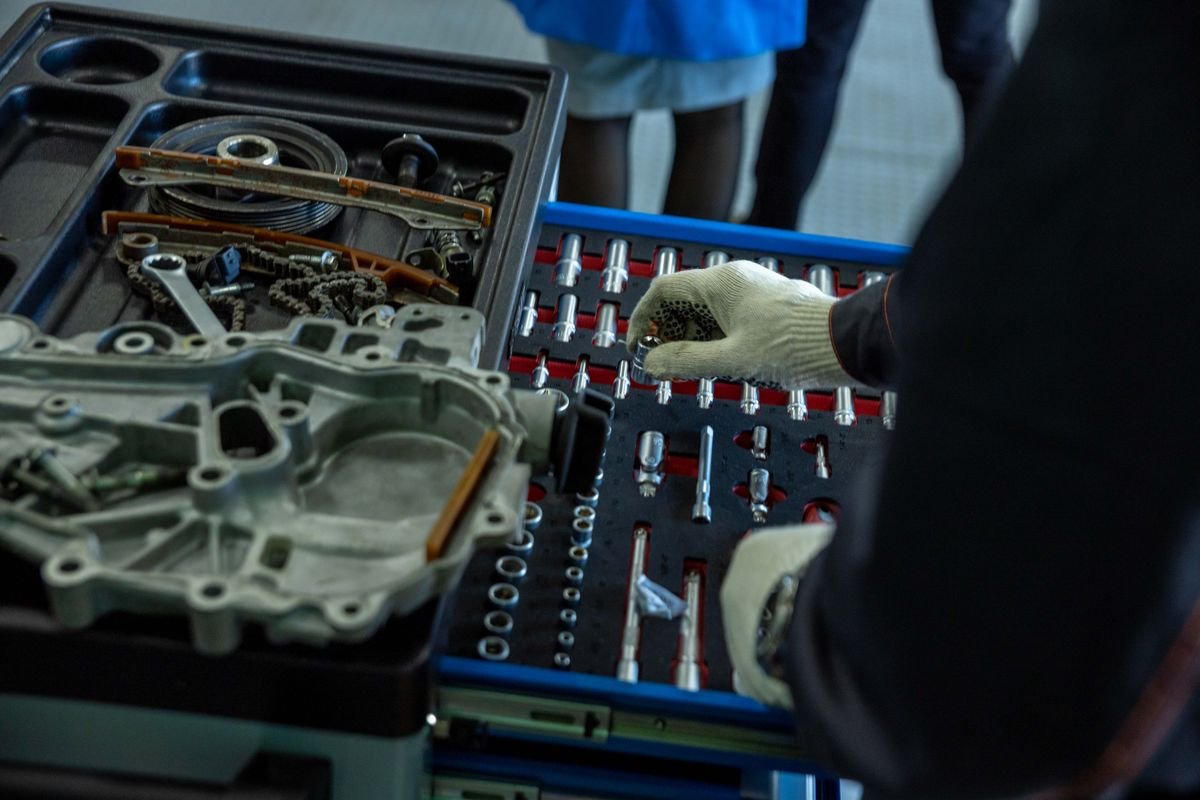
4. Physical assessment with the gearbox out
Check: Definitive assessment requires the gearbox removed. Manufacturers specify permissible rotational free play, lateral movement and tilt, measured against tolerances for that specific unit.
Next action: This is the only reliable way to condemn or pass a flywheel. If your van is having a clutch fitted, ask the garage to measure the flywheel and tell you the readings against the specification rather than simply recommending replacement.
The honest position on diagnosis
Symptoms are indicative rather than conclusive. Because the definitive check requires the gearbox to be out, and because the labour to remove it is the dominant cost, the practical decision for most owners is made at the point a clutch is being replaced.
The reasonable approach is: if the flywheel measures within specification and shows no scoring or heat damage, reuse it. If it is outside specification, worn or damaged, replace it. Fitting a new clutch to a failing flywheel is a common cause of judder and a repeat job at full labour cost.
Be appropriately sceptical of a flywheel recommendation made without measurement, and equally sceptical of a very cheap clutch quote that assumes the flywheel will be reused regardless of its condition.
Replace or convert to solid?
Solid flywheel conversion kits cost less and remove a wearing item. The trade-off is that the vibration damping the dual mass provided is lost, which typically means more noise and vibration in the cabin, more gear rattle, and additional stress passed into the gearbox.
On a hard-working van where durability matters more than refinement, a conversion can be a defensible choice. On a van used for long distances or where comfort matters, many owners regret it. Manufacturers generally do not endorse conversions, and it may have implications for any remaining warranty. Discuss it with a garage that knows your specific vehicle rather than deciding on price alone.
Indicative UK costs
Broad context only. A dual mass flywheel as a part is commonly in the mid hundreds, often more than the clutch kit itself. Because it is fitted during clutch replacement, the additional labour is minimal, but the total job on a van frequently exceeds a thousand pounds when both are done. A solid conversion kit is usually cheaper than a replacement dual mass. Ask for an itemised quote showing the flywheel separately.
Common mistakes
- Reusing a worn flywheel to save money. The most common cause of judder on a new clutch, and the labour has to be paid twice.
- Replacing it without measuring. A flywheel within tolerance does not need replacing.
- Ignoring an engine fault first. Rough running will wear the new unit too.
- Assuming any bellhousing rattle is the flywheel. Heat shields and mounts are far cheaper suspects.
- Choosing a solid conversion purely on price. Understand the noise and vibration trade-off first.
When to stop and get help
This is not a home diagnosis job beyond listening carefully and ruling out cheap causes. Get professional assessment if you have a developing rattle that changes with the clutch pedal, judder on pull-away, or vibration through the driveline. Do not delay if you smell burning or the noise is worsening quickly, because complete failure can leave the van immobile.
Prevention
Avoid labouring the engine: change down rather than pulling away or accelerating in too high a gear at low revs. Do not slip the clutch excessively. Address misfires and injector faults promptly. Avoid resting your foot on the clutch pedal. These habits genuinely extend flywheel life on a working van.
Quick reference
Difficulty: Recognising the symptoms is something any owner can do; replacement is done alongside clutch replacement as a major garage job, not a driveway task. Related fault codes: there is no dedicated fault code for DMF wear. It is a mechanical fault diagnosed by the symptoms above (idle rattle, shudder on take-up) rather than a scan tool, though a rough-running or crank sensor code can sometimes accompany severe cases and is worth investigating separately.
Post-repair checks
After replacement or a solid flywheel conversion, listen for the idle rattle and shudder to have actually gone rather than just quietened, since a partial fix can mask rather than resolve the issue. Allow the same bedding-in period as the clutch it was replaced alongside, and check for any new noise or vibration that was not present before the work, which can point at a fitting error rather than a further fault.
Frequently asked questions
Can I drive with a failing dual mass flywheel?
Usually yes in the early stages, but it worsens and in severe cases can fail completely and leave you stranded. It also passes vibration into the gearbox, so leaving it indefinitely risks a larger bill.
How long should one last?
There is no dependable figure. Use, load and driving style dominate far more than mileage alone.
Is some rattle normal?
A degree of noise at idle is normal on a diesel van. What matters is change: a new rattle, or one that is clearly worsening, deserves investigation.
Is a solid flywheel conversion a good idea?
It depends on the vehicle and how it is used. It is cheaper and removes a wearing part, but adds noise and vibration and passes more stress to the gearbox. Take advice specific to your van.
Plan the gearbox-out repair
Ask the garage to explain the evidence for flywheel wear and which engine or transmission faults have been ruled out. If the gearbox must come out, request inspection of the clutch, release system and relevant seals before deciding what to replace together. Follow the flywheel supplier limits and vehicle instructions for assessment; there is no universal acceptable amount of free movement.

2 thoughts on “Dual Mass Flywheel Symptoms on a Diesel Van”